
Views: 0 Author: Site Editor Publish Time: 2026-09-17 Origin: Site


Achieving premium table aesthetics often brings steep operational challenges. Traditional linen demands complex laundry logistics, constant sorting, and hefty replacement fees. Yet, diners evaluate hygiene and service quality the moment they sit down. A flat, unstyled setup signals low effort. Elaborate fabric arrangements drain labor hours. You need a practical middle ground. Strategic paper napkin folding provides the perfect solution. High-quality materials bridge the gap between visual appeal and operational efficiency. When done right, paper behaves like cloth but vanishes seamlessly after the meal. This guide breaks down scalable techniques for high-volume service. We detail the material requirements necessary to execute them flawlessly. You will learn how to master commercial hosting environments, ensuring your staff saves time while impressing every guest.
Diners visually evaluate your restaurant within seconds. First impressions heavily influence their perceived value of the meal. A neatly presented table suggests high hygiene standards and meticulous service. Conversely, throwing a flat, unstyled square of paper onto a table signals low effort. It feels cheap.
Business owners face a clear dilemma. You want a premium look, but you also want to avoid linen costs. Replacing linen with high-grade paper eliminates laundry shrinkage entirely. It removes third-party replacement fees. Your team stops wasting hours sorting stained or damaged cloth. Efficient restaurant napkin folding delivers the elegance of cloth without the logistical headache. You preserve a premium aesthetic while streamlining your daily operations.
Staff adoption determines the success of any new protocol. Transitioning to simple paper techniques minimizes training friction. Complex origami shapes confuse new hires and slow down table resets. During a busy Friday night rush, every second counts. Intricate setups cause table-turning delays. Simple techniques empower your front-of-house team. They learn the process in minutes. They execute the setups flawlessly. This boosts morale and keeps your dining room moving efficiently.
Structural integrity forms the foundation of any good table setup. Standard tissue or 2-ply paper lacks rigidity. If you attempt to stand a 2-ply sheet upright, it collapses. Ambient humidity in a bustling dining room quickly destroys weak paper. Thin materials look messy and absorb moisture too fast. They fail to hold sharp creases.
Heavy-duty airlaid napkins solve this problem completely. Manufacturers create airlaid paper using a web-forming process. Instead of water, they use air to bind the cellulose fibers. This unique process yields a thick, cloth-like texture. It provides excellent weight and superior edge retention. The material feels substantial in the hand. It holds vertical shapes effortlessly. Guests often mistake high-quality airlaid products for real linen.
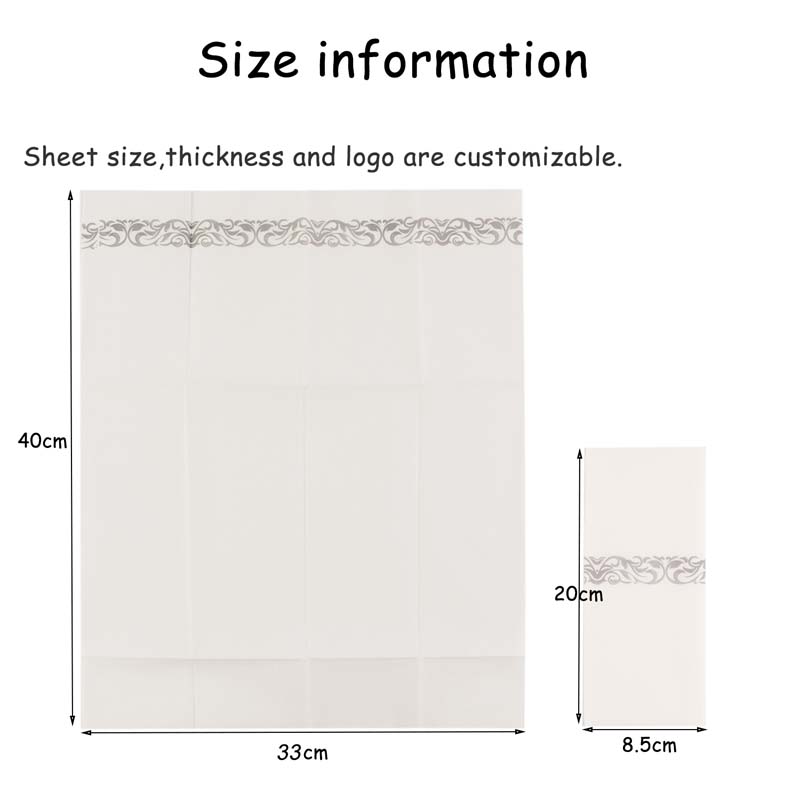
Sizing also dictates your success rate. Small beverage squares cannot accommodate cutlery. Luncheon formats lack the surface area for elegant presentation. Execution requires standard dinner napkins. These typically measure 15"x15" to 17"x17" when fully unfolded. This size provides enough material to craft pockets, tents, and wraps without looking cramped.
Table 1: Material Performance Comparison
| Material Type | Vertical Rigidity | Moisture Resistance | Best Use Case |
|---|---|---|---|
| Standard 2-Ply | Low (Collapses easily) | Low (Tears when wet) | Casual takeout, flat settings |
| Textured 3-Ply | Moderate | Moderate | Simple flat folds, lunch service |
| Airlaid (Non-woven) | High (Holds sharp creases) | High (Highly absorbent) | Premium dining, complex folding |
Mastering these basic napkin folds ensures your front-of-house runs smoothly. We selected these specific techniques for their speed, scalability, and visual impact. Each method serves a specific operational purpose.
This technique creates a neat envelope for your flatware. You fold the bottom edge up, fold the sides back, and tuck the cutlery inside. It keeps everything bundled.
The tent stands tall in the center of a plate. You fold the square in half diagonally, then fold the base corners up to meet the peak, bending it backward to stand.
A minimalist approach. You fold the square into a long rectangle, then angle it sharply across the plate. It frames menus perfectly.
This style mimics the tailored look of a man's dress shirt. You create three crisp horizontal folds, then tuck the ends under.
You roll the material into a tight cylinder and slip a decorative ring over the middle. It requires minimal dexterity.
Starting with a square, you bring the corners toward the center, creating a diamond shape. You then flip it over for a seamless surface.
You accordion-pleat the bottom half, fold it in half, and tuck the back to let the pleats fan out. This is the most traditional banquet style.
Chart 1: Setup Time Summary for Basic Folds
| Fold Technique | Average Time per Cover | Difficulty Level |
|---|---|---|
| Diagonal Wrap | 4 seconds | Beginner |
| Classic Tent | 5 seconds | Beginner |
| Diamond Flat | 5 seconds | Beginner |
| Simple Ring Roll | 6 seconds | Beginner |
| Silverware Pocket | 8 seconds | Intermediate |
| French Pleat | 12 seconds | Intermediate |
| Overlapping Fan | 15 seconds | Advanced |
Executing these designs requires careful handling. Over-handling presents a serious hygiene risk. Excessive manipulation increases surface contact between staff hands and the dining surface. You must limit touchpoints to maintain sanitary standards. Train your staff to achieve the final shape in as few movements as possible.
Crease tearing ruins presentation. Paper lacks the elasticity of cotton or poly-blends. Heavy pressure on seams will compromise the appearance. When pressing edges, use a light touch. Do not scrape your fingernails along the seams. This weakens the fibers and causes fraying.
Prep-time bottlenecks frequently occur in busy venues. Pre-folding too far in advance can lead to dust accumulation. Storing finished pieces improperly causes lost structural tension. Humidity weakens paper over time. If you prepare items days ahead, store them in sealed, rigid containers.
Your execution relies entirely on your materials. Partnering with a proven paper napkin supplier guarantees presentation consistency. Manufacturing standards vary wildly across the industry. Batch-to-batch color consistency ensures your tables look uniform. Precise square cutting prevents lopsided edges. A rectangle cannot create a perfect diamond shape.
Volume and scalability matter for seasonal operations. Assess a vendor's ability to meet peak holiday demands. Backorders during December or wedding season will cripple your service standards. Ask about their warehousing capacities and lead times for bulk freight.
Always utilize a sample testing protocol. Never buy a massive pallet without testing a small batch first. Evaluate the fold memory yourself. Does it hold a crease? Test moisture absorption by spilling a few drops of water. Check for lint residue by rubbing the surface against dark fabrics. High-quality products leave zero dust behind.
Elevating your dining room does not require expensive laundry contracts. By replacing linen with premium paper, you balance visual elevation with operational practicality. Sourcing thick, non-woven materials ensures your table settings look luxurious. Training staff on quick, repeatable techniques keeps labor costs low and table turnarounds fast.
Remember, the simplest shapes often yield the best return on investment. Complex origami slows down service and increases tearing risks. Clean, functional designs secure flatware and impress guests instantly. We encourage you to request material samples from a trusted vendor. Test these seven methods with your existing tableware and measure the time saved.
A: Yes, but they must be stored flat or in rigid containers in a climate-controlled environment. You must prevent humidity from weakening the paper's structure. Avoid stacking vertical designs, as the weight will crush the bottom layers.
A: Airlaid paper is non-woven, thicker, and highly absorbent. It mimics the drape and fold memory of real linen. Standard paper is pressed with water, making it thin, weak, and highly prone to tearing under pressure.
A: While possible, they are not recommended for commercial settings. They carry high labor costs, increased risk of tearing, and require excessive handling of the dining surface. Basic napkin folds are safer and much more efficient.