
Views: 0 Author: Site Editor Publish Time: 2026-11-14 Origin: Site


Restaurant margins are notoriously thin. Owners constantly fight food waste and optimize labor schedules. Yet, a silent cost creeps into daily operations. Consumable supplies. Without proper tracking, paper product inventory spirals out of control. Over-ordering locks up vital cash flow. It eats limited back-room storage. Under-ordering triggers sudden stockouts. This leads to hygiene emergencies, health code violations, and ruined guest experiences.
Industry data reveals a massive shift in modern procurement strategies. Inflation continues to squeeze raw material budgets. Foodservice operators now treat consumable inventory with the same data-driven scrutiny as perishable ingredients. Post-pandemic dining culture permanently elevated facility hygiene standards. A well-stocked handwashing station is no longer just a basic necessity. It acts as a critical pillar of brand reputation and customer retention.
The solution lies in accurate consumption calculation. Analyze foot traffic, specific usage rates, and product types across different zones. This guide delivers exact formulas, operational variables, and strategic choices to master your inventory and eliminate waste.
Data-backed forecasting prevents cash leaks: Standardized formulas based on guest counts stop expensive overstocking and unexpected stockouts.
Zone-specific deployment stops waste: Front-of-house restrooms and back-of-house kitchens demand entirely different dispensing hardware.
Higher absorbency reduces per-capita usage: Strategically designed rolls mean fewer sheets are pulled per handwash.
Dispenser hardware dictates consumption: Upgrading to touchless or portion-controlled units slashes paper waste by up to 30%.
Tracking paper products is not a minor administrative chore. It dictates your operational runway. Ignore it, and financial leaks compound rapidly over the fiscal year.
Pennies per sheet add up fast. A mid-sized venue burns through dozens of rolls weekly. Inefficient dispensers bleed money. Staff using premium paper for routine surface cleaning destroys profit margins. You need strict, data-backed inventory controls to survive in a highly competitive market.
Paper towels are your frontline defense against cross-contamination. Health inspectors demand fully stocked handwashing stations. Running out during a chaotic Friday rush is a direct health code violation. It risks immediate citations or forced closures. Proper tracking guarantees your sinks are always prepared.
Tracking naturally highlights behavioral waste. Eco-conscious diners evaluate your environmental footprint. Optimizing ordering schedules reduces your contribution to local landfills. Efficiency in this area aligns perfectly with broader corporate sustainability goals.
External variables drive daily fluctuations. Identify them first before applying mathematical formulas to your procurement strategy.
More covers mean more restroom visits. High table turnover generates massive restroom traffic compared to prolonged tasting menus. Track your 30-day average cover counts. Factor in seasonal spikes to align inventory with your busiest service days.
A messy BBQ joint or casual seafood boil sees extreme table-side paper usage. Guests constantly wipe their hands. Fine dining establishments utilizing linen napkins restrict paper use almost entirely to the restrooms. Analyze your specific dining style to predict guest behavior accurately.
Staff and guests behave differently. Back-of-house employees wash hands repeatedly. They handle raw meat. They switch prep stations. Kitchen staff grab paper to wipe rapid spills. Staff consumption heavily outpaces guest consumption on a per-capita basis.
Absorbency is the hidden metric. Buy cheap, thin towels, and users instinctively grab five sheets. Invest in high-quality Commercial Paper Hand Towels, and they only need one or two. Cheap paper accelerates depletion and inflates your overall monthly spend.
Stop guessing. You need empirical math to forecast procurement accurately. Relying on gut feeling inevitably leads to wasted capital.
Pull average daily cover counts from your Point of Sale system. Use a 30-day average to account for slow weekdays and busy weekends. Calculate total staff shifts per day across all roles. Accurate headcounts form the foundation of precise forecasting.
Industry benchmarks provide a solid baseline. The average restaurant guest uses 2.5 to 3 folded towels per restroom visit. Staff members use 8 to 10 towels per shift due to strict handwashing regulations and constant spill management.
Multiply total guests by 2.5. Multiply total staff by 10. Add these together for your daily towel count. Multiply the daily count by your operating days per month. Divide the monthly total by the sheets per case to determine your exact purchasing requirements.
Consider a 150-seat restaurant serving 300 guests daily, operating with 15 staff members.
User Group | Daily Headcount | Towels Per Person | Total Daily Towels |
|---|---|---|---|
Guests | 300 | 3 | 900 |
Staff | 15 | 10 | 150 |
Total | 315 | - | 1,050 |
This location burns 1,050 individual towels daily. Over a 30-day month, that equals 31,500 towels. If a supplier packages 4,000 towels per case, they mathematically require 7.8 cases. Management should set the ordering target at 8 or 9 cases to maintain a safe buffer.
A one-size-fits-all approach fails in foodservice. Different zones demand specific dispensing solutions to maximize efficiency.
Presentation matters in guest-facing areas. Restrooms reflect your brand's overall cleanliness. Deploy premium roll towels or Z-fold options. They offer tactile comfort and a hygienic appearance without encouraging excessive waste.
Commercial kitchens are high-stress environments. Line cooks cannot carefully extract folded towels with two hands mid-service. They need durable, high-wet-strength paper accessed instantly to wipe grease spills.
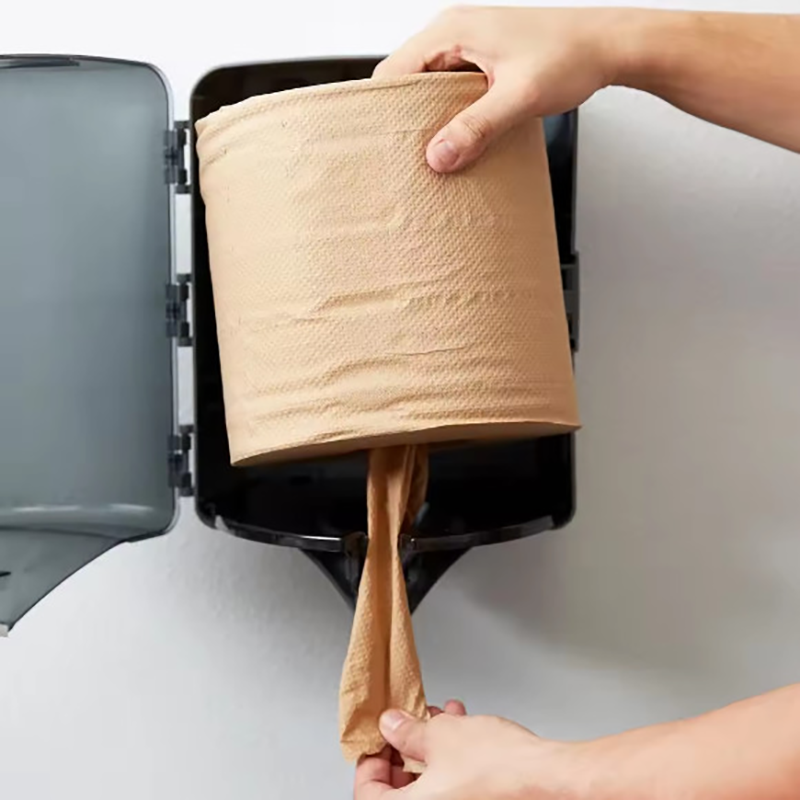
Engineered for harsh environments, Centre-Feed Paper Towels pull smoothly directly from the middle of the roll. The exterior remains completely enclosed within the dispenser. This brilliant design protects the roll from airborne grease and splashing dishwater. It allows rapid, one-handed dispensing to minimize cross-contamination at critical prep stations.
Hardware dictates access. The wrong dispenser guarantees excessive daily waste.
C-Fold and Multifold units are cheap to install. They are also notorious for causing severe bunching. Guests pull a single towel, and a clump of six falls out. Extras end up unused on wet counters or floors, driving up maintenance labor.
Touchless units control the exact sheet length. Setting it to an optimized 8 or 10 inches stops endless pulling. A slight mechanical delay before dispensing a second sheet psychologically deters guests from grabbing excess paper.
Wall-mounted centre-feed units keep paper off dirty floors. A standard roll left exposed on a stainless steel prep table absorbs wet spills and is instantly ruined. Proper dispensers eliminate this risk entirely.
Do not just buy the cheapest case on the market. Evaluate the true cost-in-use.
Roll length is a crucial procurement metric. Upgrading to 183M Recycled Centre Feed Paper Towels delivers an exceptionally long 183-meter capacity. This massive length slashes the labor costs of constant mid-shift restocking. Recycled materials also provide a strong selling point for eco-conscious restaurant brands.
Two-ply cases carry a higher upfront price tag. Their increased thickness and absorbency mean guests use fewer sheets. Users naturally grab handfuls of weak one-ply paper. Investing in two-ply frequently results in a noticeably lower overall monthly spend.
Virgin pulp offers peak softness for luxury fine dining. Modern manufacturing techniques have vastly improved recycled options. Today's recycled paper delivers excellent wet strength at a competitive price point, perfectly meeting the demands of casual dining operations.
Management must actively drive down consumption directly on the restaurant floor.
Location matters immensely. Install dispensers directly next to handwashing sinks. Place trash receptacles immediately below them. If guests walk across the restroom to dry their hands, they drip water. They then pull extra towels to wipe up the mess they just created.
Implement strict back-of-house protocols. Train employees to use reusable microfiber cloths for sanitizing dining tables. Restrict paper products to mandatory handwashing compliance or specific health-code tasks like patting dry raw proteins.
Do not rely entirely on initial forecasts. Count your dry storage inventory weekly. Compare actual usage against calculated projections. Investigate unexpected spikes immediately to see if a dispenser is malfunctioning.
Translate accurate consumption data into a bulletproof procurement strategy. Systematize ordering to prevent stressful emergency store runs.
A par level is your absolute minimum stock. If you burn 10 cases a month, your weekly par level might be 3 cases. Defining clear par levels removes emotional guesswork and prevents over-cluttering limited storage space.
Calculate safety stock to buffer supply chain delays. If delivery takes three days, calculate your 72-hour burn rate. Add that specific number to your base par level. This acts as cheap insurance during busy holiday weekends.
Storage space is highly valuable. Pallet discounts tie up operational capital and crowd the kitchen. Balance bulk benefits against a just-in-time ordering model. Keep the storage room clear but maintain highly accurate weekly forecasting.
Mastering inventory is not a matter of guesswork. It requires accurate math, choosing the right mechanical dispensers, and selecting high-efficiency products tailored to specific zones. Optimizing usage directly impacts your bottom line. It improves staff operational efficiency and ensures unwavering guest satisfaction. Audit your current usage today. Calculate your actual monthly needs. Upgrade your back-of-house supplies to high-capacity, durable options to experience immediate financial savings. Ready to optimize your consumable spend? Explore the professional-grade solutions at Ulive Paper to perfectly match your operational requirements.
A guest typically uses 2.5 to 3 folded paper towels per restroom visit. This number fluctuates based on towel absorbency and the specific dispenser installed in the facility.
Yes. Centre-feed systems allow rapid, one-handed dispensing for busy line cooks. The enclosed dispenser protects the remaining roll from airborne grease, steam, and accidental splashes.
If inventory depletes significantly faster than your daily guest count rises, you have a problem. Finding large clumps of unused folded towels in the trash points to costly dispenser inefficiencies or poor paper absorbency.
High-capacity recycled products are highly cost-effective. They offer excellent roll length to drastically reduce janitorial restocking labor while appealing to environmentally conscious consumers.
High-speed hand dryers eliminate paper waste, but paper towels remain preferred in foodservice for strict hygiene reasons. Clinical studies consistently show paper towels are far more effective at physically removing residual bacteria from hands.
Determine your average daily usage and multiply it by your supplier's lead time in days. Add a 20% buffer to account for unexpected weekend rushes or delivery delays. Add this total to your standard weekly par level.
Depending on the quality of the paper and the efficiency of the dispenser, the cost typically ranges from $0.01 to $0.03 per guest. While this seems microscopic, a venue serving 500 guests daily can spend thousands of dollars annually, making optimization critical.