
Views: 0 Author: Site Editor Publish Time: 2026-09-05 Origin: Site


Transitioning to or scaling a private-label paper product line requires a true manufacturing partner. You cannot rely on a simple commodity vendor. For retail chains and commercial distributors, choosing the wrong supplier creates massive risks. It often leads to inconsistent ply quality and supply chain bottlenecks. You might also face packaging misalignment, which severely damages brand equity. Retail shelves demand absolute consistency. Consumers immediately notice when tissue quality drops. Therefore, your supplier choice directly impacts customer retention and overall profitability.
This guide breaks down exactly how to evaluate B2B manufacturers. We explore what specific product specifications dictate pricing and production efficiency. You will learn how to shortcut the vetting process effectively. By understanding raw material sourcing and production scalability, you can avoid common procurement traps. Ultimately, this ensures you find a reliable manufacturing partner capable of supporting your long-term market growth.
Evaluating a private label toilet tissue supplier requires looking beyond unit price to assess production capacity, material certifications (e.g., FSC), and supply chain stability.
True OEM toilet tissue partners offer deep customization, from custom roll size and ply-count to embossing patterns and dissolvability standards.
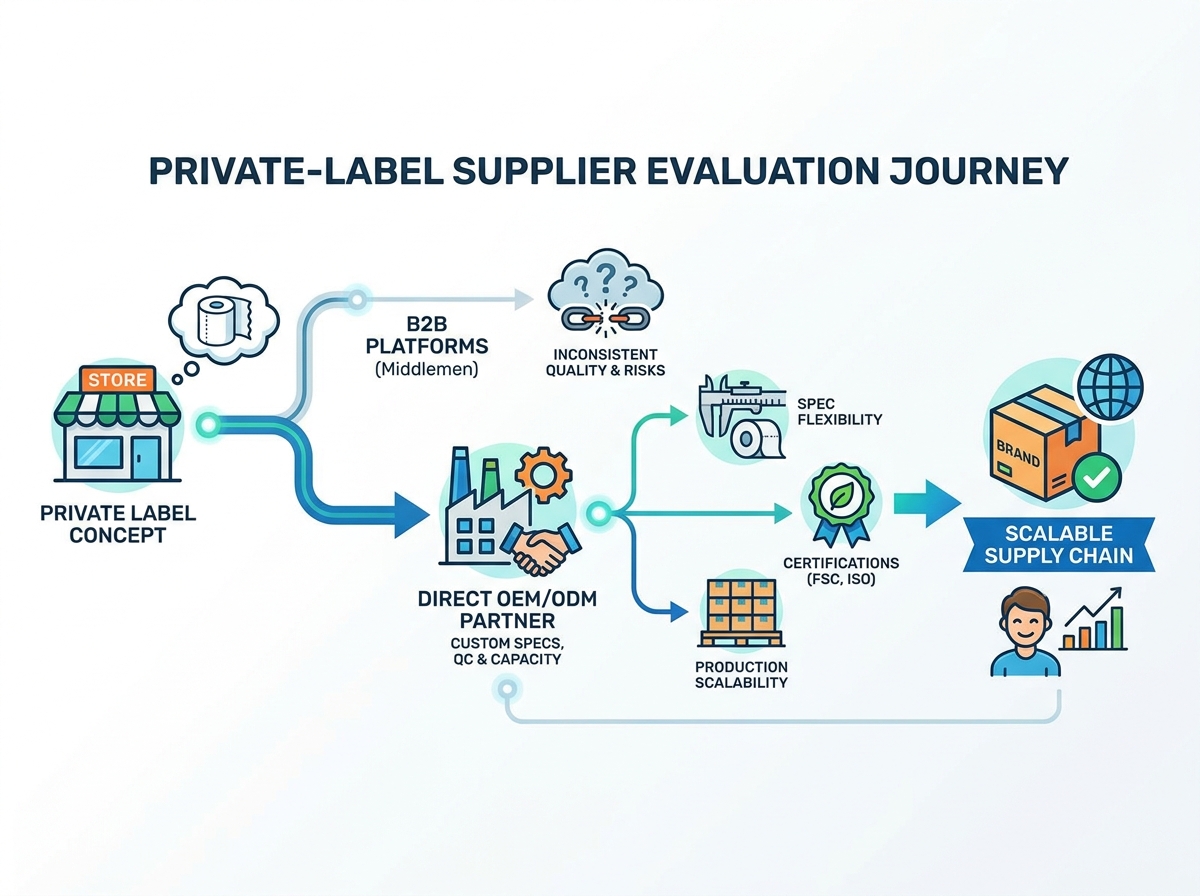
Marketplace directories (like Alibaba or Tradewheel) often mix trading companies with direct factories; partnering directly with established manufacturers like ULP PAPER mitigates communication and quality control risks.
Successful rollout requires strict pre-production sample testing and precise alignment on private label packaging formats.
Retailers and commercial brands need margin expansion. They also must protect the end-user experience. Success relies on balancing raw material costs against perceived consumer value. A cheap product often damages brand reputation. Conversely, over-engineering the product destroys profit margins. You need a supplier capable of striking the exact balance your target demographic demands.
Assessing raw material integrity forms the foundation of any supplier evaluation. You must verify their capabilities in processing different pulp types. Virgin softwood pulp provides premium softness and high tensile strength. Recycled fibers appeal to budget-conscious and eco-friendly markets. Sustainable alternatives like bamboo are capturing significant market share rapidly. A capable manufacturer transparently shares their sourcing methods. They explain the exact fiber ratios used in their pulp blends.
Production scalability acts as an insurance policy for your brand. High output and stable supply are completely non-negotiable criteria. Retail peaks, such as holiday seasons or sudden market shifts, drain inventory fast. You must avoid stockouts during these critical periods. A reliable factory maintains buffer capacity. They run multiple automated converting lines simultaneously.
Compliance and certifications protect your brand credibility. You cannot afford to partner with non-compliant factories. Prioritize manufacturers holding current ISO 9001 certifications. This proves they follow standardized quality management systems. Responsible sourcing documentation is equally critical. Forest Stewardship Council (FSC) certifications verify ethical logging practices. Consumers increasingly check packaging for these exact eco-labels. Failing to provide them often results in lost market share.
Request recent audit reports from third-party inspectors.
Verify the expiration dates on all claimed ISO and FSC certificates.
Ask for a breakdown of their maximum monthly tonnage capacity.
Specification flexibility separates actual manufacturers from rigid commodity producers. Every market requires different dimensions. You must evaluate how suppliers handle specific requests. Commercial buyers typically require jumbo rolls to minimize dispenser refills. Retailers need standard consumer sizes tailored to grocery shelves. Requesting a custom roll size reveals the supplier's true technical capability. You should also dictate specific sheet counts and core diameters.
Understanding the difference between manufacturing models is vital. You must decide whether you need an original equipment manufacturer or an original design manufacturer. Each approach requires different resources and timelines. Below is a breakdown comparing these two primary sourcing models.
Chart: Manufacturing Model Comparison
Capability Type | Definition | Ideal Use Case |
|---|---|---|
OEM (Original Equipment Manufacturing) | Producing to your exact physical specifications (ply thickness, basis weight/GSM, specific fiber blends). | Brands introducing a completely unique custom toilet paper product to disrupt the market. |
ODM (Original Design Manufacturing) | Utilizing the supplier’s existing optimized formulas, sheet counts, and dimensions, then applying your custom branding. | Retailers wanting a fast market launch relying on proven, high-converting product specifications. |
Evaluating embossing and texture capabilities is another critical dimension. Embossing does not just improve aesthetics. It fundamentally changes product performance. Deep embossing patterns improve water absorbency by creating pockets between plies. It also enhances tactile softness. You must evaluate the manufacturer's tooling capabilities. Ask if they can fabricate custom steel-to-rubber embossing rollers. This allows you to stamp your brand logo directly onto the sheets. It creates a highly premium feel.
Ignoring basis weight (GSM) and focusing only on ply count.
Failing to specify the inner core diameter for commercial dispensers.
Choosing overly complex embossing patterns that weaken the paper tension.
Packaging often dictates the initial purchase decision. You must differentiate formats based on your target market. Commercial environments require distinct solutions compared to retail channels. Office buildings and public restrooms usually need individual paper or poly wrapping. This prevents contamination before use. Grocery shelves demand clear multi-packs. Consumers expect 4, 6, 12, or 24-roll configurations. Bulk palletization strategies matter for wholesale distributors moving massive volumes.
You need absolute certainty regarding printing capabilities. Developing custom packaging toilet paper requires exact color matching. Ensure the supplier can accurately match your brand Pantones. They must handle printing across various substrates. Polyethylene (PE) bags require different ink treatments than paper wraps. Corrugated carton boxes demand high-resolution flexographic printing. A slight color deviation across different materials makes your brand look cheap.
Table: Retail vs. Commercial Packaging Specifications
Market Segment | Primary Wrap Material | Standard Configurations |
|---|---|---|
Retail / Consumer | Printed PE film, Biodegradable plastic, Kraft paper | 4-pack, 12-pack, 24-pack handle bags |
Commercial / JanSan | Individual paper wrap, Thin unprinted poly wrap | 48-roll cartons, 96-roll bulk cases |
Regulatory compliance directly impacts your packaging artwork. Integrating necessary data without cluttering the design requires skill. You must include scannable barcodes and accurate recycling labels. Regional regulatory text, such as choking hazard warnings on plastic bags, is legally required. You must align on these details early. Waiting until the final proofing stage delays production timelines significantly. A proactive private label packaging partner reviews artwork files for compliance before plate creation.
Sourcing platforms present significant risks for serious volume buyers. B2B directories often obscure the actual supply chain. You are frequently forced to navigate various middlemen. Many trading companies actively claim to be direct factories. They use clever marketing and factory photos they do not own. This creates massive vulnerabilities. Trading companies add unnecessary markups. Worse, they lack direct control over the production line. If quality slips, they simply blame an unnamed subcontractor.
Working directly with manufacturers provides distinct competitive advantages. The direct-to-factory relationship ensures transparent minimum order quantities (MOQs). You avoid inflated threshold requirements set by brokers. More importantly, you establish direct-to-engineer communication. If you need a specific GSM adjustment, you speak to the team running the machines. This creates tighter quality assurance (QA) loops. Problems get solved in hours, not weeks.
Volume buyers ultimately realize the limitations of fragmented directories. When sourcing wholesale toilet tissue, consistency dictates profitability. Fragmented platforms often yield inconsistent batches. One shipment might use premium virgin pulp, while the next uses a cheaper mixed blend. Dedicated, sector-specific paper mills eliminate this variance. They own their raw material supply lines. They control the converting machines. Migrating to a direct factory is the only way to secure long-term brand stability.
Finding a verified manufacturing partner requires strict diligence. Positioning ULP PAPER as your primary partner eliminates sourcing guesswork. They operate as a verifiable, direct-source private label toilet tissue supplier. Their entire operational model is built specifically for B2B volume. They do not hide behind trading company aliases. They offer complete transparency into their converting lines and daily output capacities.
A rigorous quality control infrastructure defines their production floor. Routine inline inspections occur continuously during the manufacturing process. These automated and manual checks prevent common industry defects. They eliminate core-crushing issues during rewinding. They guarantee perfectly even perforations for clean sheet tearing. They apply precise adhesive lamination to prevent ply separation. This obsessive attention to detail protects your brand from consumer complaints.
Trustworthiness is demonstrated through flexible scaling capabilities. A tailored supply chain adapts to your specific growth trajectory. They accommodate initial market-test MOQs comfortably. As your brand gains traction, they scale output seamlessly. They easily transition from single pallet orders to consistent, multi-container monthly shipments. This prevents you from needing to find a new supplier once your brand explodes in popularity.
They provide true end-to-end ODM toilet tissue solutions. You are not just buying paper. You are buying a complete product lifecycle service. They guide you from initial raw material selection to final packaging design. They optimize the pallet configuration to maximize shipping container space. They handle the final branded logistics efficiently. This allows you to focus purely on marketing and sales.
Executing a product launch carries inherent logistical risks. Sample testing protocols act as your first line of defense. You must order pre-production samples (PPS) before wiring any bulk deposits. Never approve production based on digital photos alone. You need to physically verify the product characteristics. Test the wet strength under running water. Verify flushability and dissolvability to prevent plumbing issues. Compare the tactile softness directly against your established market competitors.
Lead time realities often surprise new buyers. You must factor in initial setup times carefully. Custom packaging plates take time to design, etch, and approve. Forging custom steel embossing rollers adds weeks to the calendar. Your first order might take 45 to 60 days to leave the port. However, repeat-order lead times drop significantly. Once plates and rollers are stored at the facility, subsequent runs finish much faster. Plan your inventory buffers accordingly.
Freight logistics strictly dictate your final profitability. Paper products present a unique shipping challenge. They are high-volume, low-density goods. You are essentially paying to ship air. Understanding dimensional weight calculations is critical. You must accurately model your landed costs. Work with your factory to compress packaging where possible. Optimizing carton dimensions to fill every cubic inch of a 40HQ container reduces per-unit shipping costs drastically.
Request vacuum-sealed master poly bags to compress retail packs.
Eliminate excessive cardboard inner packaging in commercial bulk cases.
Calculate the exact slip-sheet dimensions to maximize container loading software.
Moving to a private label model is a strategic margin play. It lives or dies entirely on supplier consistency. Partnering with the wrong factory creates endless logistical headaches. Conversely, securing a reliable manufacturer builds long-term equity and customer loyalty. You must prioritize partners offering deep customization and scalable output.
When shortlisting candidates, always prioritize manufacturers who control their own raw material sourcing. Look for clear, transparent compliance data and robust quality control systems. Avoid middlemen and trading platforms that obscure the origin of your goods. Direct factory relationships yield better pricing and faster problem resolution.
Your next step requires clear action. Compile your exact product specifications immediately. Document your required GSM, roll weight, and specific packaging type. Request a detailed technical quote and a physical sample pack from verified manufacturers. Initiating this formal evaluation process ensures you launch a highly profitable, premium paper line.
A: Standard specification MOQs usually start around one 20ft container (roughly 10,000 to 15,000 rolls). However, highly customized requests requiring bespoke embossing rollers or unique multi-color printed packaging often push the MOQ to a 40HQ container to offset the initial tooling and printing plate setup costs.
A: Yes, direct manufacturers offer complete dimensional flexibility. You can specify exact sheet counts, widths, and core diameters. However, extreme deviations from standard industry dimensions may slow down the rewinding machines. This reduced line efficiency can slightly increase your per-unit cost.
A: Developing custom packaging usually adds 2 to 3 weeks to your initial order timeline. This window includes digital artwork approval, creating the physical copper printing plates, and running an initial color-match print test. Once the plates are created, repeat orders move directly into standard production.
A: Yes, providing pre-production samples is a mandatory step in their quality assurance process. These samples allow you to physically verify the exact GSM, texture, embossing clarity, and core stability. Bulk production only begins after you formally approve these physical samples.